The Future of Product Portfolio Strategy: Why Category Ecosystems Outperform Standalone Products

Today’s buyers are looking beyond individual products. Whether they are furnishing a home office, upgrading a commercial workspace, or creating a more organized digital environment, they increasingly expect complete solutions that are easy to source, compatible in use, and relevant to their specific needs. For you as distributors, this shift makes product portfolio strategy more important than ever. A well-planned portfolio does more than expand your catalog. It connects complementary products, creates clearer value for customers, and opens up more natural opportunities for cross-selling and long-term growth.
At LUMIVIDA, we believe the next competitive advantage lies in building category ecosystems rather than selling standalone products. In this blog, we will explore why customers prefer complete solutions, how successful distributors develop stronger product assortments, what to consider when choosing an ecosystem partner, and how LUMIVIDA can help you build a complete workspace product ecosystem.
Table of Contents
● Why Buyers Want Complete Solutions, Not Just Individual Products
● How a Category Ecosystem Creates More Value Than a Single Product
● How Successful Distributors Build Competitive Product Portfolios
● What to Look for When Choosing a Category Ecosystem Partner
● How LUMIVIDA Helps You Build a Complete Workspace Product Ecosystem
● Conclusion: Build a Portfolio That Supports Long-Term Growth
Why Buyers Want Complete Solutions, Not Just Individual Products
A standalone product can solve one immediate problem. A complete solution solves the wider context around that problem. For example, a customer buying an ergonomic chair may also need a height-adjustable desk, a monitor mount, cable-management accessories, task lighting, and storage. When these products are presented as a coordinated workspace solution, the purchase becomes easier to understand and more valuable to the customer.
Today’s buyers also expect convenience. They want to reduce the time spent comparing suppliers, confirming compatibility, arranging shipments, and finding product information. This is especially true for distributors serving retailers, online platforms, office-project customers, and corporate buyers. A complete product assortment allows you to respond to these expectations with a more efficient and professional offer.
| Buyer Need | Limitation of a Standalone-Product Approach | Value of a Category Ecosystem |
| Convenience | Customers must source related products separately | Related products can be purchased through one coordinated offer |
| Compatibility | Product combinations may be unclear | Products are selected around a clear use case |
| Speed | More supplier communication and purchasing steps | A broader solution reduces sourcing complexity |
| Confidence | Buyers assess each product in isolation | A cohesive range communicates expertise and reliability |
| Project value | Lower opportunity for bundled sales | More complete packages can increase order value |
We believe the best category management starts with this question: What complete problem are we helping the customer solve? Once that answer is clear, product selection becomes more strategic.
How a Category Ecosystem Creates More Value Than a Single Product
A category ecosystem is a deliberately connected product assortment. It brings together products that share a customer, a space, a use case, or a buying journey. Instead of treating every SKU as an independent sales opportunity, you can organize your range around how people actually use products.
Take LUMIVIDA's products as examples, an ergonomic seating range can combine chairs with pillows and cushions, while a digital-accessories range can connect laptop stands, lighting, cables, hubs, and cleaning kits. In the same way, office organization can extend from cable management to mobile file cabinets. These connections help customers see a complete solution rather than a collection of unrelated products.
| Product Category | Core Products | Complementary Products | Customer Outcome |
| Ergonomic Seating & Comfort | Chairs | Pillows & cushions | A more comfortable and supportive workspace |
| Digital & Laptop Accessories | Laptop/tablet/phone stands & holders | laptop bags & backpacks, lighting, pads & mats, etc. | A more flexible, connected, and efficient digital setup |
| Office Organization & Storage | Cable management | Mobile file cabinets | A cleaner, more organized, and productive workspace |
| Home Storage | Appliance mounts & holders | Kitchen storage racks | Space-saving, easy access to household equipment |
Effective category management also improves internal decision-making. Rather than adding products because they are individually popular, you can evaluate whether each SKU has a clear role in the portfolio. Does it fill a price gap? Does it complete a use case? Does it create a logical add-on sale? Does it serve a specific channel or customer type? This discipline helps you avoid an unfocused catalog. More products do not automatically create more value. The right products, connected in the right way, do.
How Successful Distributors Build Competitive Product Portfolios
A successful product portfolio is built with intention. It balances market demand, product relevance, profitability, supply reliability, and room for future growth. The goal is not to carry every possible item. The goal is to create a range that customers can understand, trust, and return to. We recommend building your portfolio in 3 layers, as demonstrated in the image.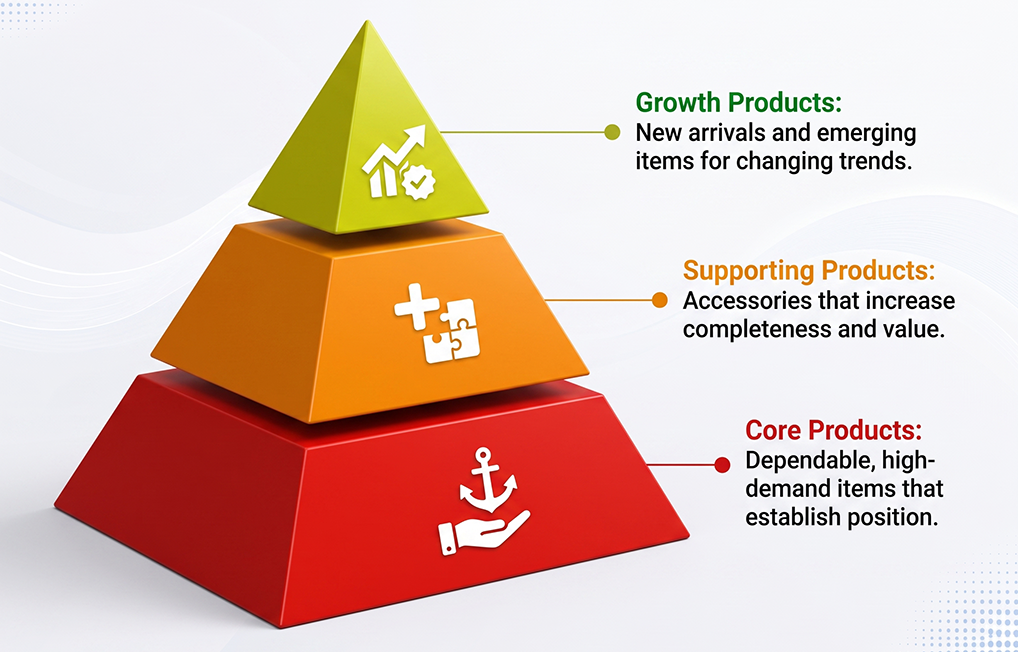
This structure makes your portfolio easier to manage. It also gives customers a reason to buy from you at different price points and at different stages of their purchasing journey.
For instance, a distributor entering the office-furniture category might begin with chairs, desks, and monitor mounts as core products. The next step could include cable-management products, storage, and desktop accessories. As the category matures, the portfolio can expand into ergonomic accessories, smart-office items, and tailored product bundles for specific sales channels.
| Portfolio Layer | Main Purpose | Typical Decision Criteria |
| Core products | Build category credibility and sales volume | Demand, quality, price competitiveness, stable supply |
| Supporting products | Increase bundle potential and customer convenience | Compatibility, attach rate, margin opportunity |
| Growth products | Capture new demand and refresh the offer | Trend relevance, market feedback, launch support |
The strongest distributors also use customer feedback as a portfolio-building tool. Your sales data can show which products are frequently purchased together. Your customers can tell you where they face sourcing gaps. Your retail partners can identify what is missing from their shelves or online listings. These signals should shape your product portfolio strategy.
What to Look for When Choosing a Category Ecosystem Partner
Creating a complete offering requires more than finding products. You need a partner that can support the operational side of portfolio growth: sourcing, quality control, inventory, delivery, product development, and marketing. When evaluating a category ecosystem partner, consider the following areas:
● Product breadth: Can the partner help you build a connected assortment across relevant categories?
● Sourcing capability: Does the partner have access to reliable supplier resources and new-product opportunities?
● Quality management: Are supplier evaluation, testing, certification, and production follow-up processes in place?
● Inventory flexibility: Can you start with manageable quantities and respond quickly to demand?
● Order management: Can the partner simplify multi-SKU orders, delivery coordination, and replenishment?
● Marketing support: Are product images, videos, catalogs, packaging, and sales materials available?
● Long-term scalability: Can the partner grow with your portfolio and adapt to new markets or channels?
A product range can look promising on paper but become difficult to scale if supply is unstable or product information is incomplete. For this reason, the right partnership should combine commercial opportunity with operational reliability.
You should also assess whether the partner understands the difference between a product supplier and a solution provider. A solution-oriented partner can help you identify product gaps, optimize your range, develop customer-specific products, and launch new categories more efficiently.
How LUMIVIDA Helps You Build a Complete Workspace Product Ecosystem
At LUMIVIDA, we are building a dedicated B2B platform designed to make sourcing easier for our global partners. We help you move from individual products to a more complete workspace product ecosystem by combining product breadth, centralized purchasing, flexible service, and practical marketing support.
Our role begins with product access. We offer a broad selection of carefully sourced SKUs across workspace-related categories, including office furniture, chairs, office supplies, electronics, cables, gaming products, and household products. This gives you a stronger foundation for building coordinated solutions rather than sourcing every category from a separate supplier.
We also understand that portfolio development needs flexibility. You may want to test a new category, launch an online assortment, respond to a project opportunity, or add complementary items to an established product line. Through LUMIVIDA brand products, you can access ready inventory with no minimum order quantity requirement, helping you reduce the barriers to trial and market entry.
For customers with more specific requirements, we provide customer-brand-based sourcing. This can combine OEM sourcing with LUMIVIDA inventory, allowing you to pursue a tailored product range while still benefiting from our sourcing and supply-chain capabilities.
| LUMIVIDA Capability | How it Supports Your Business |
| Two service modes | Let you choose LUMIVIDA brand products or customer-brand-based sourcing according to your needs |
| Centralized sourcing | Helps you access a broader product assortment through one partner |
| Ready inventory and no MOQ | Supports faster product testing, flexible purchasing, and easier replenishment |
| Supplier network | Provides access to diversified supplier resources and responsive sourcing options |
| Quality and supply-chain management | Supports supplier evaluation, certification, production follow-up, and quality control |
| Smart warehouse operations | Helps manage complex orders and improve inventory visibility and order accuracy |
| Marketing service | Provides product images, graphic design, video, catalogs, packaging, and display support |
Among these, marketing is a crucially important part of a successful ecosystem. A complete range needs clear product content to sell effectively. We provide standardized marketing collateral for LUMIVIDA brand products, including high-resolution product and scene images, 3D renderings, product videos, posters, brochures, and packaging. For customer-brand-based sourcing, we can also support packaging, manuals, display solutions, and selected marketing services.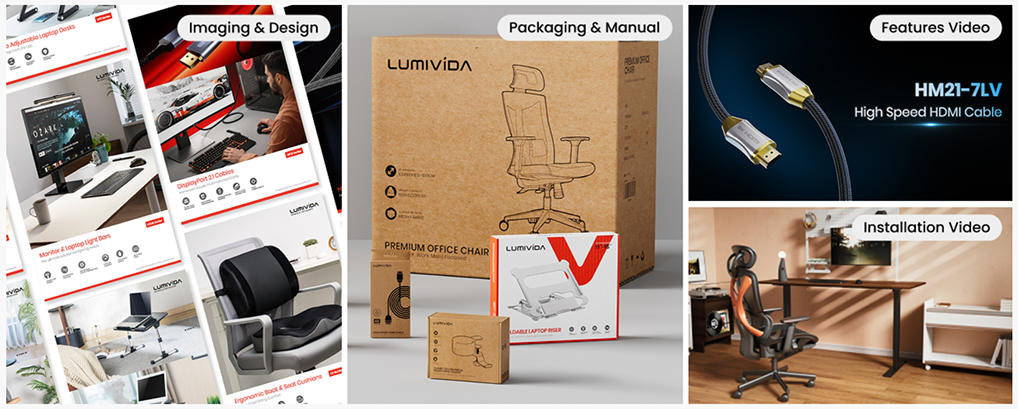
This combination allows you to focus on your market and customer relationships while we help support the product, sourcing, operational, and launch side of the business.
Conclusion: Build a Portfolio That Supports Long-Term Growth
The future of distribution belongs to businesses that make buying easier, not more complicated. A strong category ecosystem helps you deliver complete solutions, improve customer loyalty, increase cross-selling opportunities, and create a more resilient position in the market. Your next stage of growth may not come from adding one more standalone product. It may come from building a more thoughtful product portfolio: one that connects categories, solves real workspace needs, and gives customers a clearer reason to choose you.
At LUMIVIDA, we are ready to help you develop that ecosystem. Together, we can turn a product assortment into a more complete, scalable, and market-ready workspace solution.